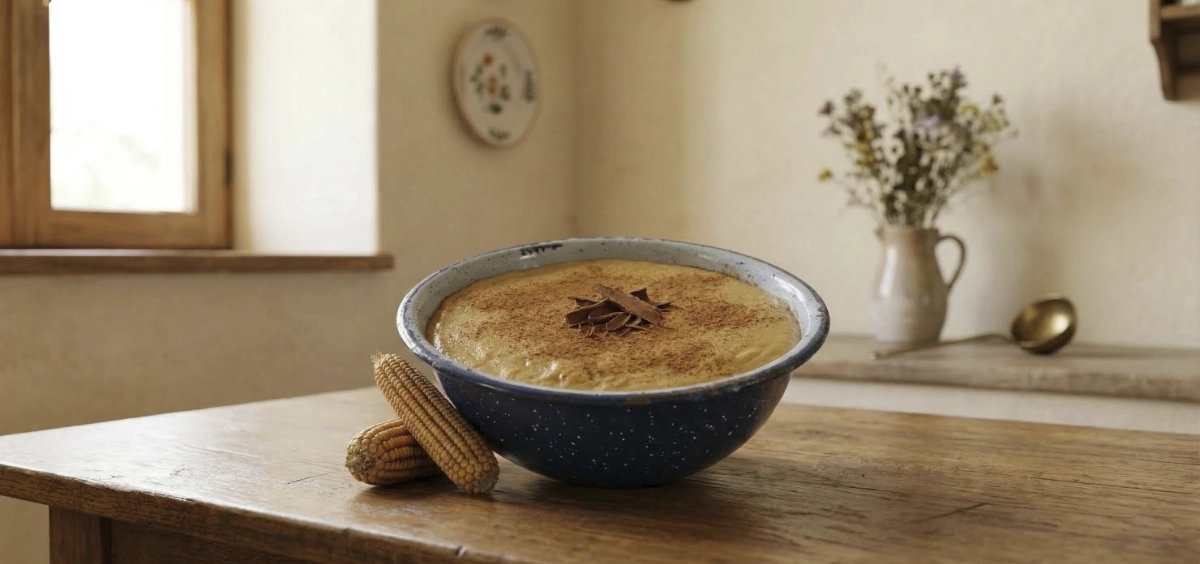
Venezuelan majarete is one of those desserts that cannot be understood through the recipe alone, but through everything surrounding it: corn, coconut, slow cooking… and even the dish it is served in. When talking about Venezuelan majarete, a familiar phrase often comes up: “if it’s majarete, it’s better in enamelware.” This is not just nostalgia; it has technical, cultural, and practical meaning.
This dessert is part of Venezuela’s traditional repertoire, documented by authors such as Armando Scannone and food historians like Rafael Cartay, where corn is not only the base of savory dishes but also central to sweet preparations. Majarete is not a decorative dessert; it is a structural one, where every decision — ingredients, cooking, cooling — directly affects the final result.
VENEZUELAN MAJARETE: ORIGIN AND STRUCTURAL LOGIC
Majarete traces back to colonial cuisine, with strong Indigenous and African influences. The use of corn comes from pre-Columbian traditions, while coconut, sugar, and spices were incorporated during the colonial period, creating a hybrid preparation that became established across the Caribbean.
In Venezuela, it is associated with home cooking and traditional celebrations, especially in coastal and central regions. It is not a restaurant dessert; it is a home dessert, built on patience and repetition. That is precisely why execution makes such a difference.
VENEZUELAN MAJARETE: TECHNIQUE AND COOKING POINT
The base of majarete starts with ground corn or corn flour, combined with coconut milk, sugar, cinnamon, and sometimes panela (unrefined cane sugar). It appears simple, but process control defines the outcome.
The first critical step is dissolution. The corn must be mixed in cold liquid to avoid lumps; if added directly to heat, it coagulates unevenly. Then it is cooked over medium heat, stirring constantly.
At this stage, starch gelatinization occurs — the process that thickens the mixture. If not stirred, it sticks; if cooked too aggressively, the texture breaks. The correct point is reached when the mixture thickens evenly and begins to slightly pull away from the bottom of the pot.
There are no shortcuts here. It requires attention throughout.
VENEZUELAN MAJARETE: COOLING AS PART OF THE PROCESS
One of the most common mistakes is assuming majarete is finished once the heat is turned off. In reality, cooling is a key phase.
During resting, the starch structure stabilizes, allowing the majarete to firm up without becoming rigid. If cooled improperly or in unsuitable containers, the texture changes.
This is where enamelware becomes relevant.
VENEZUELAN MAJARETE AND ENAMELWARE: BEYOND TRADITION
Enamelware has a documented presence in Venezuelan households throughout the 20th century, valued for durability and thermal behavior.
In the case of majarete, enamelware dissipates heat more evenly than plastic or thick glass containers. This allows gradual cooling, reduces condensation, and helps maintain a more stable texture.
It also facilitates clean slicing and prevents excessive sticking. That is why the phrase persists — it reflects repeated, practical experience over generations.
CONTRAST: TRADITIONAL VS MODERN VERSIONS
Today, simplified versions of majarete are common, often using industrial thickeners or shortened cooking times. The result is usually more uniform, but less complex.
Traditional majarete retains a slightly grainy texture, with the corn still perceptible. Modern versions tend to be overly smooth or gelatinous, losing identity.
Excess sugar is another frequent issue, masking the balance between coconut and corn. The original preparation is more restrained and structured.
COMMON ERRORS THAT CHANGE THE RESULT
Failing to properly dissolve the mixture leads to lumps. Cooking at high heat creates uneven texture or burning.
Not stirring constantly causes sticking and flavor alteration. Skipping proper resting time prevents the dessert from setting correctly.
A more subtle mistake is not adjusting sweetness based on coconut intensity. A good majarete is balanced, not overly sweet.
A LOGIC SHARED BY VENEZUELAN DESSERTS
Majarete is not an isolated case. Many Venezuelan desserts follow the same principle: simple ingredients, precise execution. Quesillo depends on controlled bain-marie cooking; tres leches on absorption balance; layered desserts like marquesas on proper chilling.
In all cases, the outcome depends less on the recipe and more on execution.
WHEN DETAILS DEFINE THE RESULT
Serving majarete in enamelware summarizes an entire way of understanding cooking. It is not about aesthetics; it is about coherence.
It is the accumulation of small, correct decisions that defines the final result.
A CURRENT APPROACH FROM PANNA
At Panna, majarete is not part of the menu, but the same logic applies. It is present in every dessert we offer: tres leches, quesillo, golfeados with cheese, marquesas, and cakes designed to pair with coffee.
Each one reflects the same principle: technique, balance, and respect for tradition. It is not about replicating everything, but about understanding why things work.
Because in majarete, as in any Venezuelan dessert, the result is not defined only by ingredients. It is defined by how it is made, how it is served… and by those details that seem small, but are not.