Venezuelan perico is one of the most recognizable breakfast dishes in the country, yet also one of the most misunderstood from a technical standpoint. When people talk about Venezuelan perico, they often reduce it to scrambled eggs with tomato and onion… and that is where the problem starts. Because yes, that is the base, but it is not the only version, nor necessarily the most complete.
Perico is a structure, not a fixed recipe. It is a format that allows real variations documented in Venezuelan cuisine, from the simplest version to those enriched with proteins such as bacon, ham, or even dogfish. Understanding this is what allows it to be executed properly.
VENEZUELAN PERICO: ORIGIN AND LOGIC OF A FLEXIBLE DISH
Perico emerges in Venezuelan home cooking as a practical solution: enhancing eggs with a quick sofrito. Authors like Armando Scannone and studies from Fundación Bigott place it within the traditional breakfast structure, typically served with arepas or bread, as part of a functional and adaptable table.
It is not a rigid or ceremonial dish. It is everyday, flexible, and deeply Venezuelan in its ability to adapt to what is available. That is why multiple versions exist, all valid within its logic.
VENEZUELAN PERICO: THE CLASSIC BASE (TOMATO AND ONION)
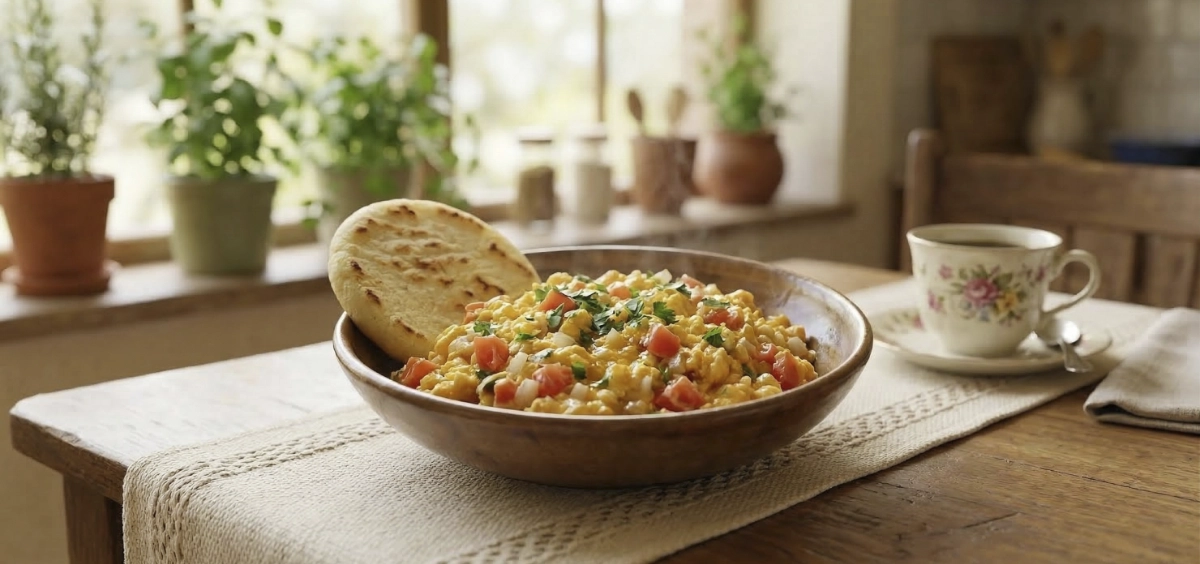
The most widespread and recognizable version combines eggs, tomato, and onion. This is the technical foundation of perico.
The process begins with the sofrito: onion is cooked until translucent, then tomato is added and allowed to release moisture and concentrate flavor. This step is essential, not optional.
Eggs are added only after the sofrito is ready. This is a critical point: cooking must be controlled to maintain a moist texture, not a dry one. Perico is not fried; it is gently set.
This version defines the standard. Everything else builds from here.
VENEZUELAN PERICO: PROTEIN VARIATIONS (BACON AND HAM)
In many Venezuelan households, especially in urban settings, perico is enriched with proteins such as bacon or ham. This is not a modern adaptation; it has long been part of domestic variations.
Technique shifts slightly. Bacon is cooked first, releasing fat that is then used for the sofrito. This adds depth and changes the texture of the dish.
Ham, on the other hand, is incorporated into the sofrito or just before the eggs, depending on its cut. Its role is to provide saltiness and structure.
A key technical point appears here: seasoning must be adjusted. Failing to do so results in an unbalanced perico.
VENEZUELAN PERICO: THE DOGFISH VERSION (LESS KNOWN, BUT AUTHENTIC)
In Venezuela’s coastal regions, particularly in the east, there is a lesser-known but fully authentic variation: perico with dogfish (cazón).
The dogfish, previously cooked and shredded, is added to the sofrito before the eggs. This transforms the dish into a more intense preparation, with stronger flavor and higher protein content.
This variation is documented within regional Venezuelan cuisine, where fish consumption at breakfast or early meals is more common than in other parts of the country.
It is not a mainstream version, but it is entirely legitimate.
PERICO WITHOUT VEGETABLES: WHEN EGGS TAKE CENTER STAGE
There is also a version of perico without vegetables, especially in contexts where ingredients are limited or speed is required. While technically closer to scrambled eggs, it is still referred to as perico in some Venezuelan households.
The difference lies in execution: the same moist, controlled texture is expected. The most common mistake is overcooking.
CONTRAST: WELL-MADE PERICO VS IMPROVISED SCRAMBLED EGGS
The difference is not in the ingredients, but in the technique.
A proper perico has a developed sofrito, creamy eggs, and a cohesive texture. Improvised scrambled eggs mix everything without order, resulting in excess moisture or dryness.
There is also a difference in intent: perico seeks balance; improvised eggs simply solve a need.
COMMON MISTAKES THAT BREAK THE DISH
Adding eggs before the sofrito is ready dilutes the mixture. Cooking over high heat dries the eggs. Poor stirring creates uneven texture.
Another mistake is not adjusting timing depending on the variation. A perico with bacon behaves differently from a simple one; fat changes how eggs cook.
And a crucial one: not respecting moisture. Dry perico is poorly executed perico.
PERICO AS AN OPEN STRUCTURE
One of the defining characteristics of perico is that it is not a rigid recipe. It is an open structure that allows variation without losing identity.
Tomato and onion define the base, but from there it can be enriched depending on context: cheese, proteins, or even lighter versions.
What matters is that the technique remains consistent.
PERICO, AREPA, AND REAL BREAKFAST
Perico is rarely eaten alone. It is designed to accompany arepas, bread, or cassava flatbread. Its role is to provide moisture and flavor to otherwise neutral bases.
That is why texture is essential. If it is dry, it fails its purpose.
A CURRENT APPROACH FROM PANNA
At Panna, we understand this type of preparation as part of the real context of Venezuelan cuisine. It is not only about individual products, but about how they come together on the table.
Perico is not the core of our offering, but it is part of the culinary language that connects with our empanadas, arepas, and breakfast experiences.
Because in Venezuelan cuisine, what matters is not only what is served, but how everything works together.