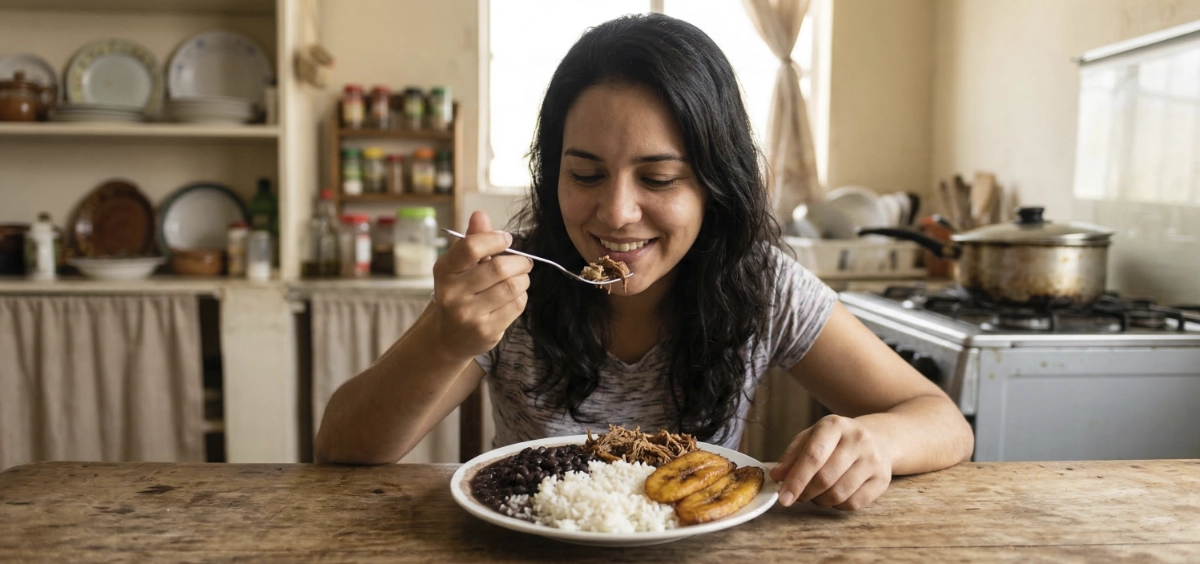
Venezuelan black beans, known as caraotas negras, are not just another side dish; they are a structural component of everyday cooking. In dishes like pabellón criollo, their role goes beyond flavor: they regulate moisture, balance fat, and provide depth. When properly executed, they hold the entire plate together; when they fail, everything feels disjointed.
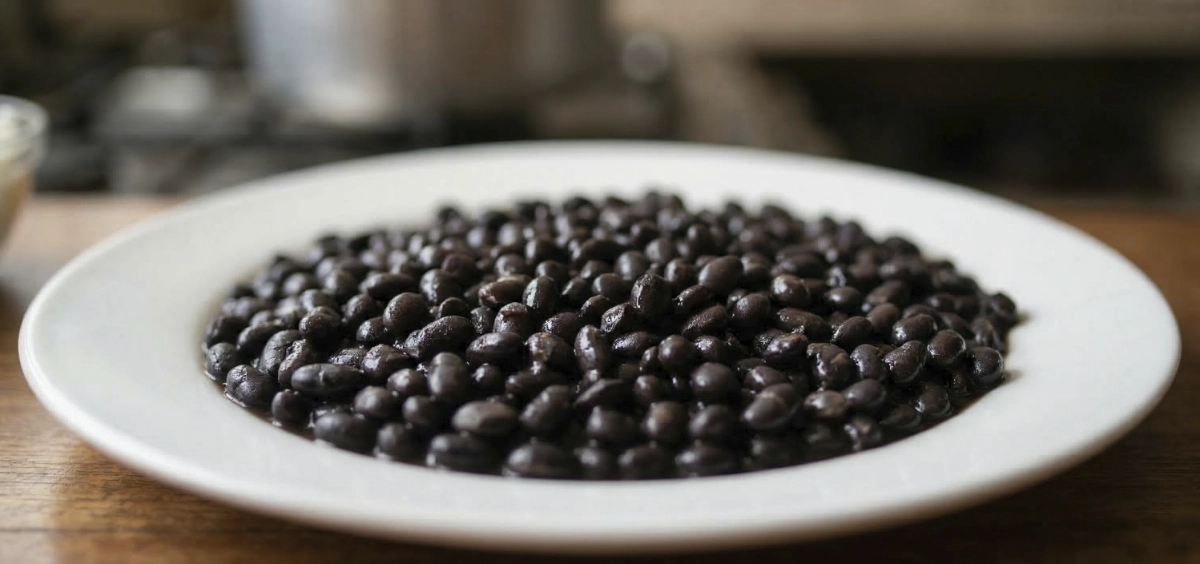
In Venezuela, these are not treated as generic black beans. Caraotas have their own identity, both in technique and in final texture. They should be neither watery nor dry; they must be “bien montadas,” meaning cohesive, glossy, and with enough body to integrate with rice without disappearing or overpowering it.
VENEZUELAN BLACK BEANS: SOAKING, HYDRATION, AND INITIAL CONTROL
The first critical step happens before cooking even begins. Soaking is not optional; it is controlled hydration that ensures even cooking. Ideally, beans should soak for 8 to 12 hours in clean water.
This process reduces cooking time and prevents uneven texture. Poorly hydrated beans tend to split externally while remaining firm inside. This introduces a key principle: cooking starts cold.
The soaking water should always be discarded. Not for aesthetic reasons, but because it contains compounds that affect both digestibility and flavor. This detail, often overlooked, has a direct impact on the final result.
COOKING VENEZUELAN BLACK BEANS: TIME, HEAT, AND STRUCTURE
Once hydrated, the beans are cooked in fresh water over medium heat, without salt at the beginning. This is essential. Salt added too early toughens the outer skin, slowing internal cooking.
Cooking time typically ranges from 60 to 90 minutes in a regular pot, depending on bean quality. Pressure cooking reduces time, but introduces a trade-off: if not carefully controlled, it can compromise texture due to rapid water absorption.
The goal is not only to soften the bean, but to preserve its structure. Properly cooked caraotas should be tender inside while remaining intact.
THE SOFRITO: WHERE FLAVOR IS BUILT
Beans alone do not define the dish. Flavor is constructed through the sofrito. In Venezuelan cooking, this typically includes onion, garlic, and ají dulce, and is added once the beans are already cooked.
A common mistake is adding the sofrito too early. This dilutes aromatic compounds and results in a flat profile. The sofrito must be incorporated toward the end to preserve its intensity.
Cumin is often used in small amounts, but requires restraint. Excessive use overwhelms the dish and disrupts balance.
WATERY VS “BIEN MONTADAS”: A REAL DIFFERENCE
In Venezuela, the distinction between mediocre beans and properly made caraotas lies in their final consistency, referred to as “montaje.”
Watery beans lack body and cohesion. Properly mounted beans have a slightly thickened broth, achieved through controlled starch release from the beans themselves.
This is not done with external thickeners. Instead, part of the beans may be lightly crushed to integrate starch into the liquid. This simple technique is a key point of execution.
CONTRAST: WHY THEY ARE NOT JUST BLACK BEANS
Although part of the broader family of black beans across Latin America, Venezuelan caraotas are treated differently. In some cuisines, beans are served more liquid or heavily seasoned; in Venezuela, the focus is balance and integration.
Acidity is not dominant, and spices are controlled. The goal is a deep, clean flavor that complements rather than competes.
TECHNICAL INSIGHT: BEANS AS MOISTURE AND FAT REGULATORS
The most important and often overlooked insight is this: caraotas do not just add flavor, they regulate the plate. Their starch content allows them to absorb and redistribute liquids and fats.
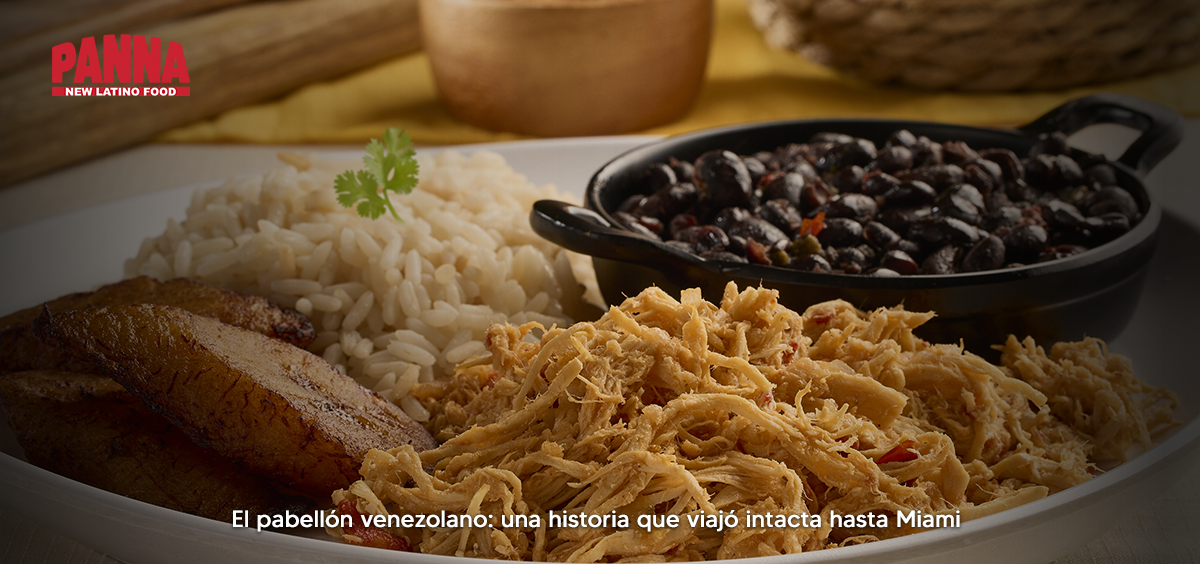
In pabellón, for example, they balance the richness of shredded beef and the sweetness of fried plantains. Without them, the dish loses cohesion. When poorly executed, the plate becomes heavy or unstructured.
From a technical standpoint, this behavior is linked to starch-lipid interactions, widely documented in food science, where starch acts as a medium for absorption and redistribution.
COMMON ERRORS THAT ALTER THE RESULT
Adding salt too early hardens the beans. Another frequent issue is poor water control, leading to inconsistent texture.
Overcooking is equally problematic. Beans that break down lose structure and become pasty. At the same time, underdeveloped sofrito results in lack of depth.
Reheating without adjusting liquid can cause excessive thickening. This should be corrected by adding small amounts of water and reheating gently.
A FOUNDATION THAT DEFINES THE CUISINE
Venezuelan black beans are more than a side dish; they are a foundation. Their correct execution is essential to understanding how Venezuelan cuisine works: balance, integration, and control.
And when looking for Venezuelan food in Miami that respects this structure, caraotas are a clear benchmark. Because it is not enough to include them; they must be done correctly.
At Panna, that level of execution is maintained consistently, because in dishes like pabellón, balance does not depend on a single element, but on how all components work together.