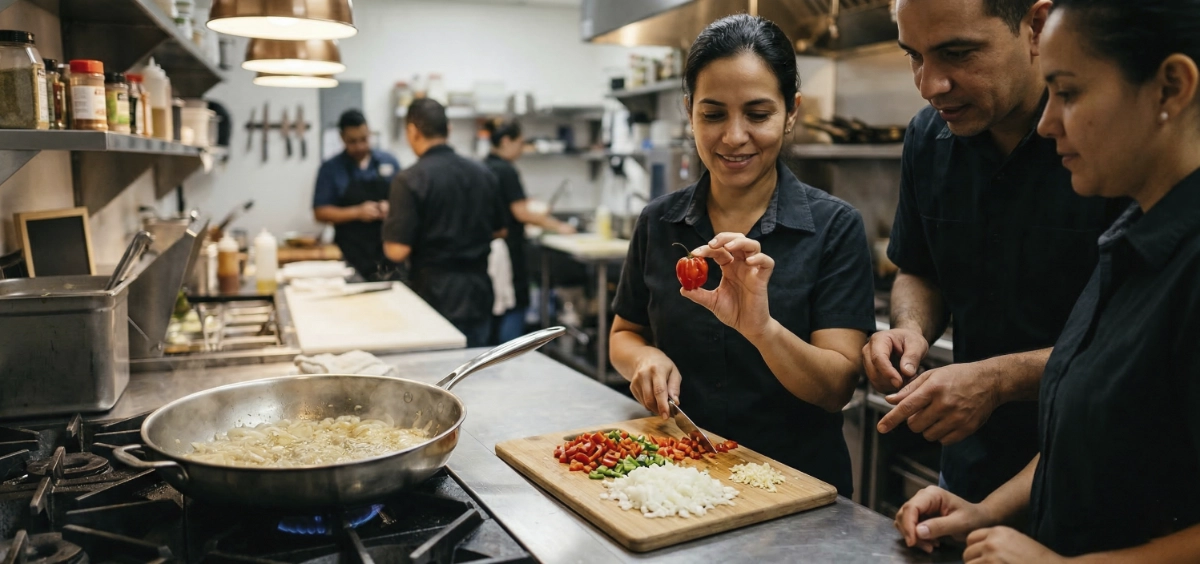
The Venezuelan ají dulce is not just another ingredient; it is a structural element of the country’s flavor system. Unlike spicy peppers, its function is not to add heat but to build aroma, depth, and identity. In Venezuelan cuisine, the absence of ají dulce is immediately noticeable, because it directly affects the final profile of the dish.
This small pepper, widely used in everyday cooking, is essential in the preparation of sofritos, stews, and fillings. Its contribution is subtle but decisive. Without it, many dishes lose their characteristic balance, becoming flatter and less expressive.
AJÍ DULCE VENEZOLANO: ORIGIN, VARIETY, AND CULTURAL USE
Ají dulce belongs to the Capsicum chinense species, the same botanical family as the habanero. However, through regional adaptation and selection, it developed a completely different sensory profile, maintaining aroma while eliminating pungency.
In Venezuela, it is used daily in both home kitchens and professional settings. It is not considered optional. Its presence in the base of many dishes explains why Venezuelan food has a recognizable aromatic signature, even before tasting.
Different regions use slightly varied shapes and sizes, but the function remains consistent: to provide a fragrant, rounded base without overwhelming the palate.
TECHNICAL FUNCTION IN COOKING: BASE OF THE SOFRITO
The primary use of ají dulce is within the sofrito, where it is combined with onion, garlic, and sometimes scallions. The key is controlled cooking. It should be sautéed at medium heat, never aggressively fried.
Excessive heat destroys its volatile aromatic compounds, reducing its effectiveness. Proper technique allows it to release its natural sugars and aromatic oils gradually, integrating into the base without becoming dominant.
This is where many preparations fail: overcooking the ají dulce eliminates the very quality that makes it essential.
CONTRAST: WHY IT IS NOT A SUBSTITUTE FOR OTHER PEPPERS
One of the most common mistakes outside Venezuela is replacing ají dulce with bell peppers or other mild varieties. While visually similar, they are not functionally equivalent.
Bell peppers lack the same aromatic concentration and sweetness profile. As a result, dishes prepared with substitutes often feel incomplete or unbalanced.
This distinction is not subjective; it is structural. Ají dulce is not interchangeable because its role is specific.
TECHNICAL INSIGHT: AROMA AS A STRUCTURAL COMPONENT
The key insight is that ají dulce contributes more to aroma than to taste in the traditional sense. Its volatile compounds interact with fats and heat to create a layered aromatic base that supports the entire dish.
This explains why its impact is often perceived before the first bite. It prepares the palate, creating expectation and coherence.
From a technical perspective, it acts as a bridge between ingredients, softening transitions and enhancing integration.
A CORE ELEMENT OF VENEZUELAN COOKING
Ají dulce is not a garnish or a secondary ingredient. It is part of the foundation. Its consistent use across different dishes reveals a shared structure within Venezuelan cuisine.
Understanding its role is essential to understanding how the cuisine works as a whole. Without it, the system loses cohesion.
And when looking for Venezuelan food in Miami that respects authentic flavor construction, the presence of ají dulce becomes a clear indicator of technical fidelity.
At Panna, this ingredient is treated with the precision it requires, because real Venezuelan flavor is not built on intensity, but on balance.