Shredded beef in Venezuelan food is not just a filling or another protein within a dish; it is one of the preparations that best represents how Venezuelan cuisine actually works. It appears in arepas, empanadas, pabellón criollo, and many everyday combinations, but its importance lies not only in its versatility, but in how it is built.
Because properly made shredded beef does not depend on a single step, but on a complete sequence: cooking the meat, shredding it correctly, and most importantly, integrating it with a proper guiso. When any of those stages fail, the result changes completely. And in a cuisine like Venezuelan food, where flavor depends on coherence, that difference is immediately noticeable.
Shredded beef in Venezuelan food as a structural element of the dish
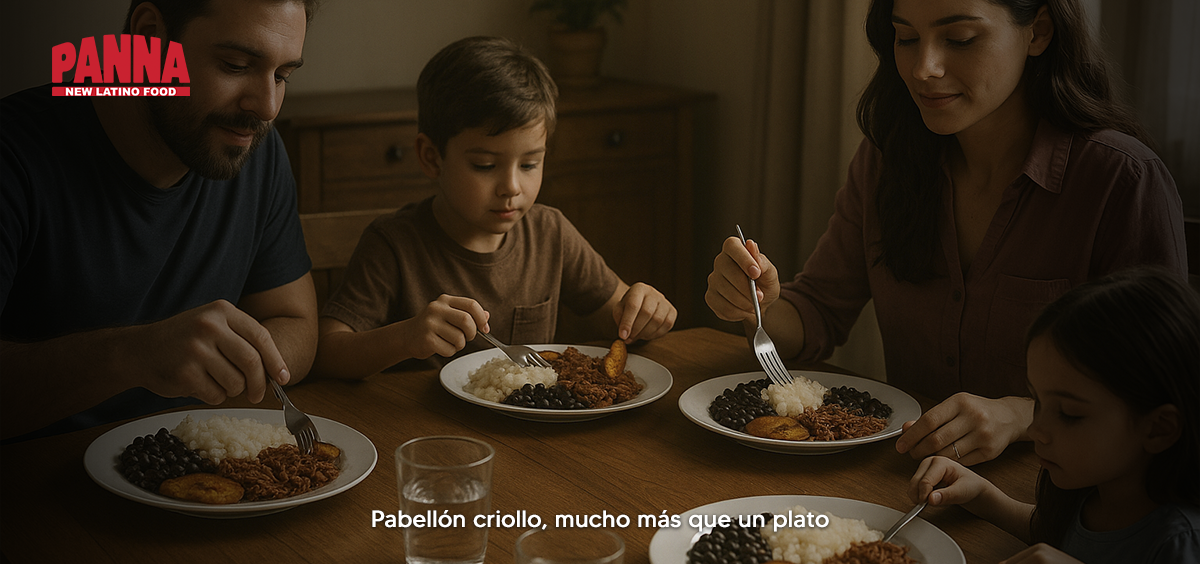
Within Venezuelan food, shredded beef functions as a base that adapts to different formats without losing identity. It can be inside an arepa, used as an empanada filling, or served as part of a pabellón on a flat plate, alongside white rice, black beans, and fried sweet plantain slices.
In all these cases, its role is the same: to provide flavor, texture, and cohesion. It is not meant to stand alone, but to integrate into a larger structure. That is why its preparation cannot be superficial; it must follow a logic that allows it to work across different contexts.
Shredded beef does not seek individual protagonism; it contributes to balance within the dish.
Choosing the right cut for shredded beef in Venezuelan food
Shredded beef in Venezuelan food begins with selecting the proper cut. Traditionally, cuts like flank or eye of round are used because they allow for long cooking and clean shredding.
Not every cut works. The meat must have long fibers that can be separated easily once cooked, without turning into an uneven mass.
The quality of the cut directly affects both texture and how well the meat absorbs the guiso later in the process.
Cooking the meat: the real starting point
Before shredding, the meat must be cooked correctly. In Venezuelan cuisine, this is usually done in water with salt and simple aromatics, allowing the meat to soften while maintaining structure.
The correct point is when the meat is tender enough to be pulled apart, but not so soft that it falls apart on its own.
Overcooking leads to a loss of texture; undercooking makes proper shredding difficult. That balance is the first quality checkpoint in the process.
Shredding technique: precision and structure
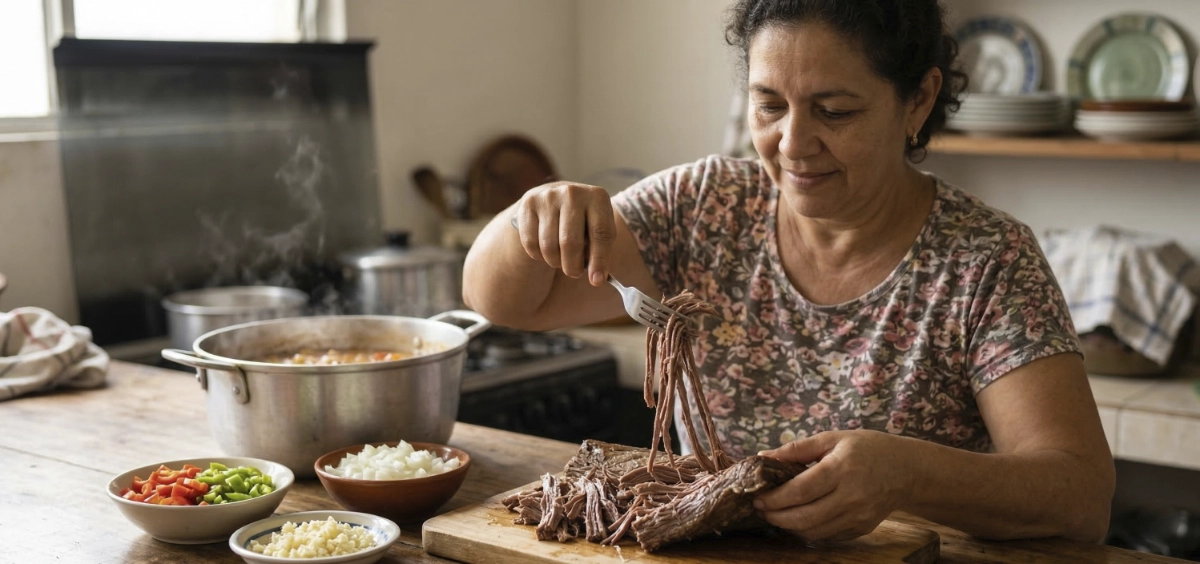
In Venezuela, the meat is not “chopped” or “crumbled”; it is shredded following the natural direction of the fibers. This detail is not only linguistic, it is technical.
The process involves separating the meat into thin strands, not irregular chunks. This allows the meat to integrate properly with the guiso and ensures consistency in every bite.
When shredding is done incorrectly, the texture becomes uneven and the final result loses definition.
The role of guiso in shredded beef
Shredded beef in Venezuelan food is not finished once it is shredded; that is where the real transformation begins.
The meat is incorporated into a well-developed guiso, where onion, garlic, sweet pepper, and bell pepper have already released their flavor. This is where the meat absorbs the full profile of the dish.
The guiso is not a finishing touch; it is the medium where the meat becomes what it is supposed to be. Without that integration, shredded beef remains incomplete.
Common mistakes in shredded beef preparation
One of the most common mistakes is preparing the meat without a proper guiso or with an underdeveloped one. This results in flat flavor that depends on external sauces to work.
Another frequent issue is incorrect shredding, which breaks the natural fiber structure. Overcooking is also common, leading to a pasty texture that loses definition.
These mistakes are not always visible at first glance, but they are immediately noticeable when eating.
Shredded beef in everyday Venezuelan cooking
In everyday Venezuelan life, shredded beef is a recurring preparation. It is used across multiple meals throughout the week, adapting easily to arepas, empanadas, or full plates.
This versatility is not accidental; it comes from its ability to maintain coherence across different formats.
Like many guiso-based preparations, it often improves over time. From one day to the next, the flavors integrate more deeply, becoming more balanced.
Shredded beef in Venezuelan food in Miami
In cities like Miami, where Venezuelan food has grown significantly, shredded beef is widely used. However, not all versions follow the correct technique.
Anyone familiar with the preparation can quickly identify when the meat has been properly shredded, correctly integrated with the guiso, and well executed overall.
For those looking for Venezuelan food in Miami, shredded beef serves as a clear indicator of quality.
At Panna, shredded beef is built from the foundation
At PANNA, shredded beef in Venezuelan food is prepared by respecting every stage of the process. From selecting the right cut to integrating it into the guiso, everything is done with a focus on coherence.
It is not just about cooking meat; it is about building a flavor that works within the full structure of the dish.
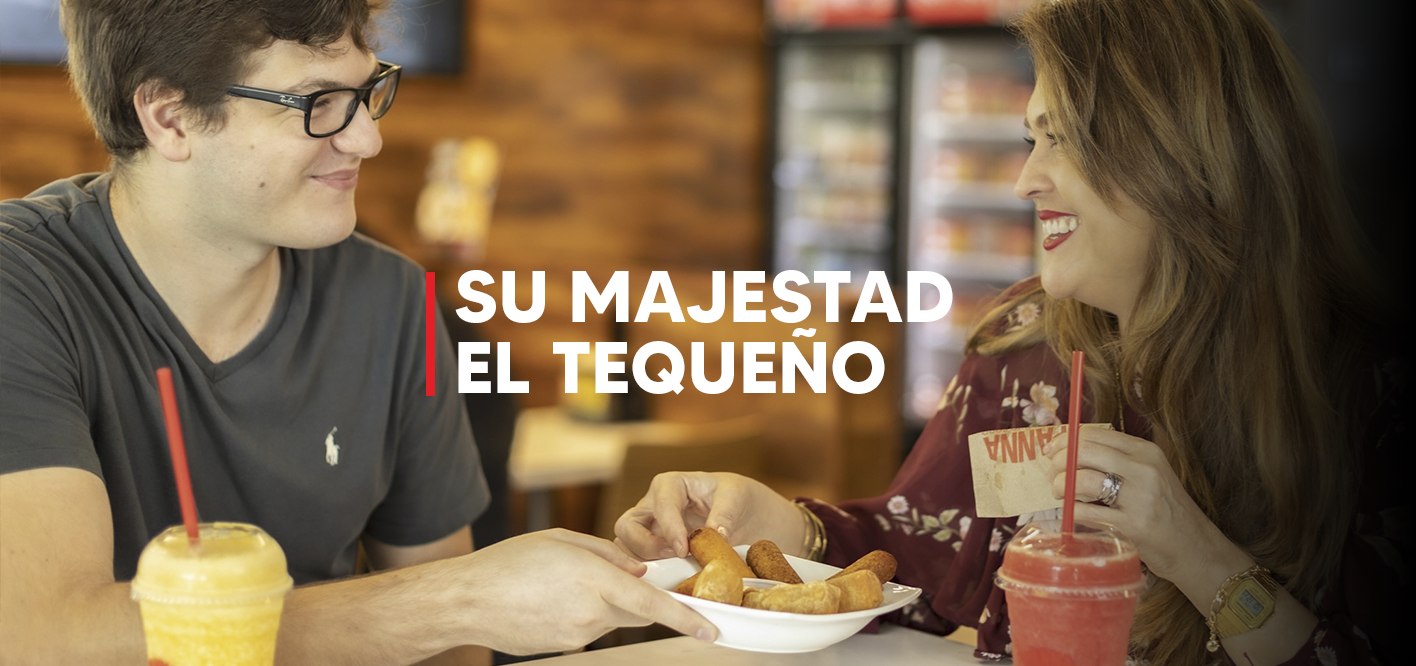
It is used in empanadas, arepas, and other preparations where its role is clear: to add identity without disrupting balance.
If you are looking for Venezuelan food in Miami where shredded beef has proper texture, depth, and structure, PANNA offers an execution that respects both technique and the logic of Venezuelan cuisine.