Venezuelan asado negro is one of the most emblematic dishes of Caracas cuisine, but also one of the most debated when it reaches the table: is it better with rice or with pasta? The question seems simple, but it actually opens a technical and cultural discussion about how a complete Venezuelan plate is built.
Because asado negro is not just beef in a dark sauce. It is a complex preparation, where the balance between sweetness, acidity, fat, and texture requires a side that can truly support it. That is where rice and pasta play completely different roles.
VENEZUELAN ASADO NEGRO: ORIGIN AND STRUCTURAL LOGIC
Asado negro originates in colonial Caracas cuisine, documented in cookbooks such as those by Armando Scannone and in studies of Venezuelan gastronomy by authors like Rafael Cartay and José Rafael Lovera. It evolved from European slow-cooking techniques, adapted with local ingredients such as panela (raw cane sugar).
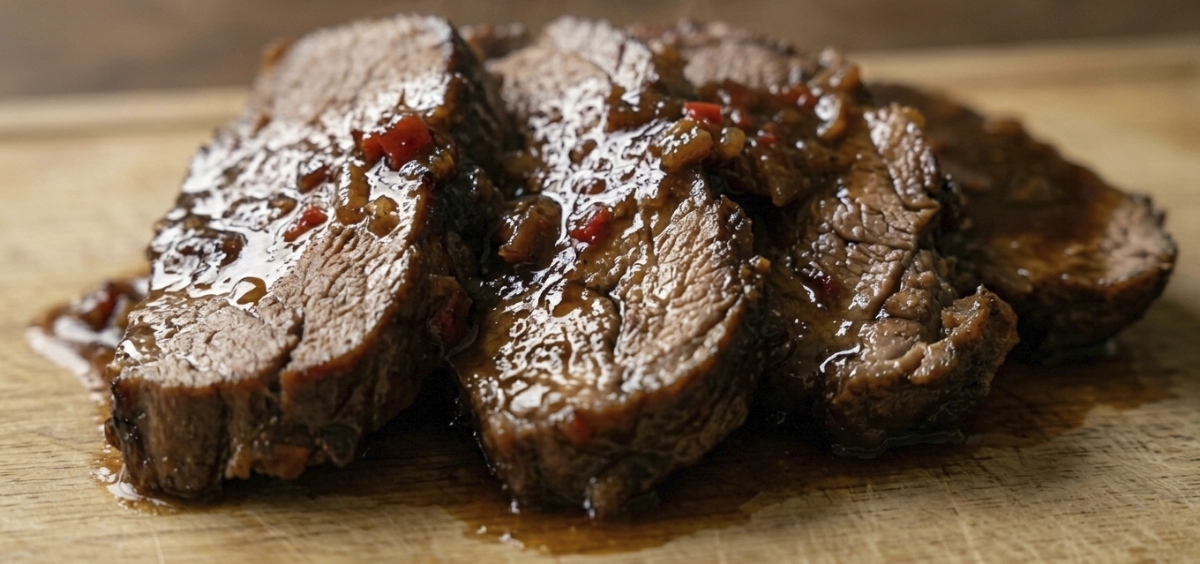
The cut of beef, typically eye of round, is first seared and then slowly braised in a sauce made with caramelized sugar, wine, broth, and spices. The result is tender meat with a dense, dark sauce that carries a complex flavor profile: sweet, savory, and slightly acidic.
That profile defines everything else. The side dish is not decorative; it is structural.
VENEZUELAN ASADO NEGRO: TECHNIQUE AND SAUCE PRECISION
The first critical point is the caramel. It is not simply melted sugar; it must be pushed to the edge without burning. If overcooked, it becomes bitter; if underdeveloped, it lacks depth.
Then comes the searing of the meat, which builds a crust that helps retain juices. After that, slow cooking in liquid transforms the dish: the meat tenderizes while the sauce reduces and concentrates.
The final balance depends on reduction. A sauce that is too thin will not coat properly; one that is too thick becomes heavy. The correct point is a coating consistency that clings without overwhelming.
WHITE RICE: THE CLASSIC COUNTERBALANCE
White rice is the most traditional side for asado negro, and for good reason.
Rice provides neutrality. Its function is to absorb the sauce without competing with it. Technically, rice acts as a regulator of intensity, balancing the sweetness of the caramel and the strength of the reduction.
Its loose texture allows the sauce to distribute evenly. Each bite becomes balanced almost automatically.
From a structural perspective, rice turns asado negro into a complete dish, where protein and carbohydrate complement rather than compete.
PASTA: A DIFFERENT INTERPRETATION OF THE SAME DISH
Pasta, although less traditional, is a real variation within Venezuelan cuisine, especially in urban contexts.
Here, the logic changes. Pasta does not absorb the sauce in the same way rice does; it coats itself with it. This creates a more intense experience, where the asado negro sauce becomes the dominant element.
This has consequences. If the sauce is not perfectly balanced, pasta amplifies its flaws. Excess sweetness or over-reduction becomes more noticeable.
For that reason, asado negro with pasta demands greater precision.
TECHNICAL CONTRAST: RICE VS PASTA
The key difference lies in function:
Rice absorbs and balances.
Pasta coats and intensifies.
Rice corrects small imperfections in the sauce; pasta exposes them.
Rice lightens the dish; pasta makes it heavier and more concentrated.
From a technical standpoint, rice is more forgiving. Pasta is more demanding.
COMMON MISTAKES WHEN SERVING ASADO NEGRO
One frequent mistake is pairing it with sides that compete with the sauce. Asado negro is already a loaded dish; it does not need additional complexity.
Another error is not adjusting the amount of sauce depending on the side. With rice, you can be more generous. With pasta, control is essential.
It is also common to overlook the texture of the meat. If it is not properly tender, no side dish can compensate for that.
THE CULTURAL FACTOR: TRADITION VS ADAPTATION
In many Venezuelan households, rice is the default choice. It is part of the classic structure of the dish.
However, pasta appears as a modern adaptation, influenced by urban habits and availability. It is not incorrect; it is simply another interpretation.
This reflects a constant in Venezuelan cuisine: tradition coexists with adaptation.
WHICH ONE IS BETTER? IT DEPENDS ON THE INTENTION
If the goal is balance, rice is the better option.
If the goal is intensity, pasta works better.
It is not about right or wrong, but about what you want the dish to achieve.
A CURRENT APPROACH FROM PANNA
Asado negro is not part of Panna’s direct offering, but it represents a way of understanding Venezuelan cuisine: technique, balance, and respect for the product.
That same logic is present in the dishes that are part of our menu, where every element has a clear role within the whole.
Because in Venezuelan cuisine, it is not only about what is served, but how the plate is constructed as a complete experience.