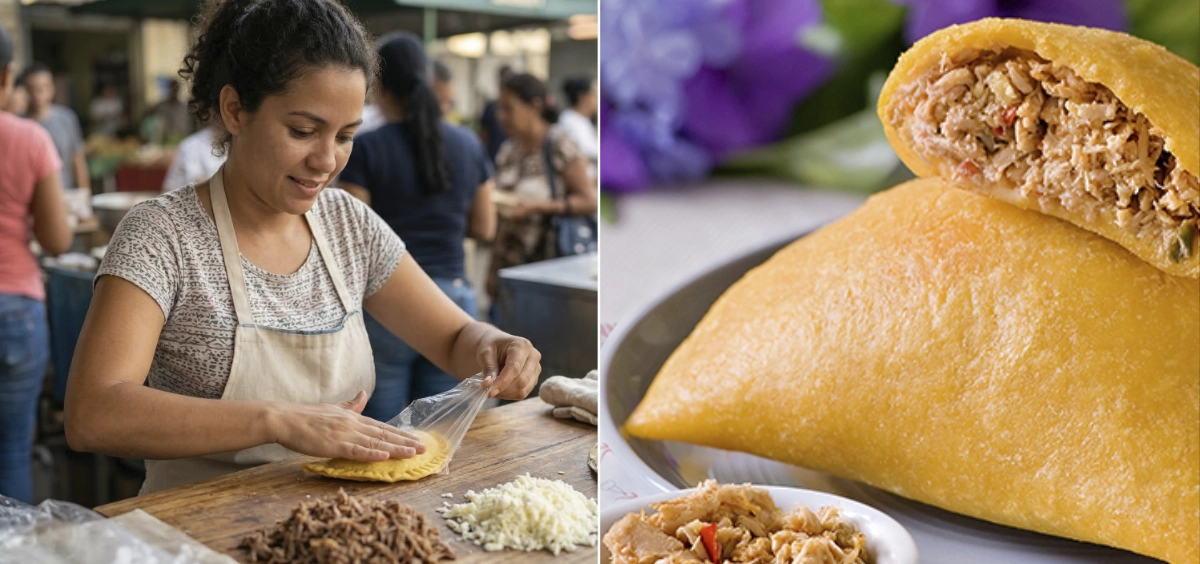
Venezuelan empanadas are one of the most representative dishes in Venezuelan food, not only because of how frequently they appear in everyday life, but because they embody a complete logic of flavor, texture, and technique. They are not simply fried dough with filling; they are a structured dish where each component plays a specific role, and where the final result depends on how well everything is integrated.
In Venezuela, empanadas are part of the daily rhythm. They show up early in the morning, at roadside stands, on the beach, in markets, and in homes where quick meals still need to deliver real flavor. Their presence is not accidental; it comes from their versatility, their ability to adapt to different fillings, and their efficiency as a complete meal. However, behind that apparent simplicity lies a set of technical decisions that determine whether an empanada truly works.
Venezuelan empanadas in Venezuelan food as a complete structure
When discussing Venezuelan empanadas in Venezuelan food, it is important to understand that they are not just a snack. They are a complete dish designed to solve a meal with a minimal number of elements, but in a well-balanced way.
The dough provides the carbohydrate base, the filling introduces protein and flavor, and the frying defines the final texture. Nothing is unnecessary, and nothing is missing. That efficiency is part of their success.
Unlike other cuisines where empanadas may be thinner or more decorative, Venezuelan empanadas have substance. They are meant to be filling, properly stuffed, and satisfying enough to stand on their own.
Venezuelan empanada dough: texture, proportion, and execution
The dough is one of the most critical components of Venezuelan empanadas. It is made primarily from pre-cooked corn flour, water, and salt, giving it a distinctive texture that sets it apart from wheat-based empanadas found in other Latin American cuisines.
Achieving the right consistency is essential. The dough must be soft enough to shape, yet firm enough to hold the filling without breaking. If it is too dry, it cracks; if it is too wet, it loses structure.
When forming the empanada, the dough is not rolled into a thin sheet. Instead, it is flattened by hand, maintaining a certain thickness. This allows the empanada, once fried, to develop a crispy exterior while remaining soft inside, without becoming heavy or greasy when properly executed.
Venezuelan empanada fillings: real logic and traditional combinations
The fillings of Venezuelan empanadas follow a clear principle: they must be flavorful on their own, but also integrate properly with the dough. Not every preparation works inside an empanada.
Common fillings include shredded beef, ground beef, shredded chicken, and cheese. Each requires a specific preparation to function correctly. Shredded beef, for example, is cooked with guiso to retain moisture and depth of flavor; ground beef must be cohesive, not loose; shredded chicken follows a similar logic, ensuring consistency in every bite.
Cheese, on the other hand, introduces contrast. Typically fresh white cheese is used, which softens when heated without losing structure. The balance between the saltiness of the cheese and the texture of the corn dough is one of the most recognizable combinations in Venezuelan cuisine.
More complex fillings also exist, such as pabellón, which combines shredded beef, black beans, and fried sweet plantain slices inside the empanada. In these cases, the challenge lies in maintaining balance without overwhelming the interior.
Frying Venezuelan empanadas: the technique that defines the result
Frying is the step that ultimately defines Venezuelan empanadas. It is not a minor detail; it determines whether the dough becomes crispy or heavy, whether it absorbs oil or maintains structure.
The oil must be at the right temperature, hot enough to quickly seal the surface, but not so hot that it burns the exterior before the inside is properly cooked. If the oil is too cold, the empanada absorbs excess grease; if too hot, it browns unevenly.
Empanadas are deep-fried, fully submerged, allowing for even cooking. The correct result is a golden, firm exterior with a crisp texture that breaks cleanly when bitten, revealing a soft, well-integrated filling inside.
Venezuelan empanadas in everyday life
In daily Venezuelan life, empanadas are not occasional; they are constant. They are eaten as quick breakfasts before work, during road trips, at the beach, or as a practical solution for a complete meal.
Their consistency comes from their functionality. They do not require complex side dishes, they can be eaten by hand, and they satisfy hunger directly and efficiently.
They also allow variation without losing identity. The filling may change, but the structure remains.
Venezuelan empanadas in Venezuelan food in Miami
In cities like Miami, where Venezuelan food has established a strong presence, empanadas have become one of the most recognizable dishes. However, not all follow the same logic.
Anyone familiar with Venezuelan cuisine can tell when the dough is properly made, when the filling makes sense, and when the frying has been correctly executed. These details separate a well-made empanada from one that simply exists.
For those searching for Venezuelan food in Miami, empanadas often serve as a clear indicator of quality.
At Panna, empanadas follow a clear culinary logic
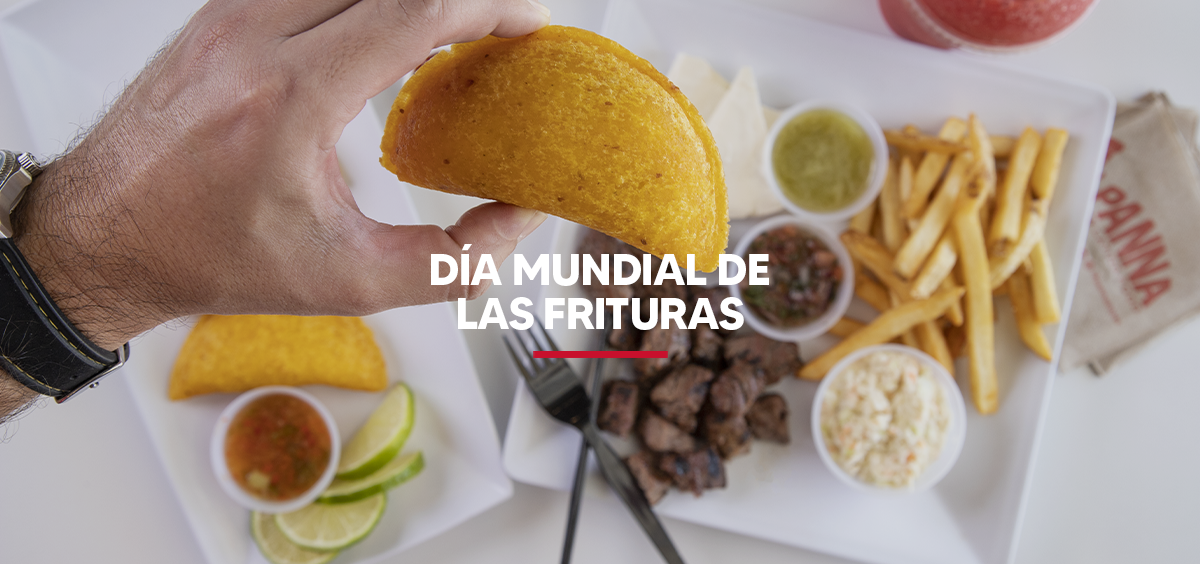
At PANNA, Venezuelan empanadas are prepared with the understanding that each component must work within a cohesive system. The dough is made with the right consistency to hold the filling without losing texture; the fillings are cooked to integrate, not to overload; and the frying process is controlled to achieve balance.
The options reflect real tradition: cheese, shredded beef, ground beef, shredded chicken, and pabellón. There are no forced combinations or unnecessary variations.
If you are looking for Venezuelan food in Miami where an empanada is not just a quick bite but a properly built dish, PANNA offers an execution that respects the real logic of Venezuelan cuisine, where every step in the process matters.