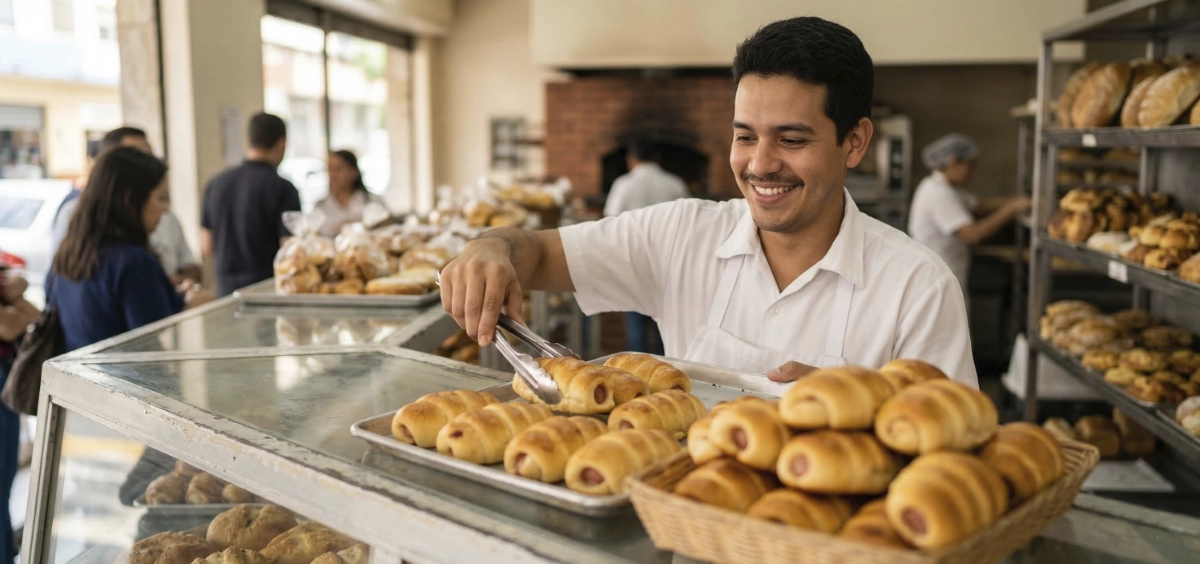
Venezuelan cachitos are such a natural part of everyday Venezuelan food that they often go unnoticed. They are there early in the morning, in bakeries, cafés, offices, and homes, solving breakfasts and quick meals without complication. However, behind that apparent simplicity lies a clear history, a defined evolution, and a culinary logic that explains why they remain one of the most consistent products in Venezuelan cuisine.
Unlike more structured dishes, cachitos do not rely on complexity to stand out; they rely on efficiency. They are a well-designed solution: wheat dough, a simple filling, and proper baking. Even within that basic structure, there are technical and cultural decisions that have defined their permanence over time.
Origin of Venezuelan cachitos in Venezuelan food
The origin of Venezuelan cachitos is directly linked to European baking traditions, particularly French and Italian influences that arrived in Venezuela during the late 19th and early 20th centuries. With European immigration, especially in cities like Caracas, new bread-making techniques were introduced and gradually adapted to local habits.
One of the clearest references is the French croissant, both in shape and in the concept of rolled dough. However, the Venezuelan cachito is not a direct copy. Unlike the croissant, which uses laminated dough with butter, the cachito developed with a simpler dough, without lamination, adapted to local ingredients and processes.
Throughout the 20th century, Venezuelan bakeries—especially in urban centers—began shaping this product into what we now recognize as the cachito: a filled, baked bread with a clear function in the daily breakfast routine.
This was not a single invention but rather a gradual evolution within the bakery system, particularly in Caracas, where cachitos became a standard offering.
Venezuelan cachitos in Venezuelan food as a breakfast solution
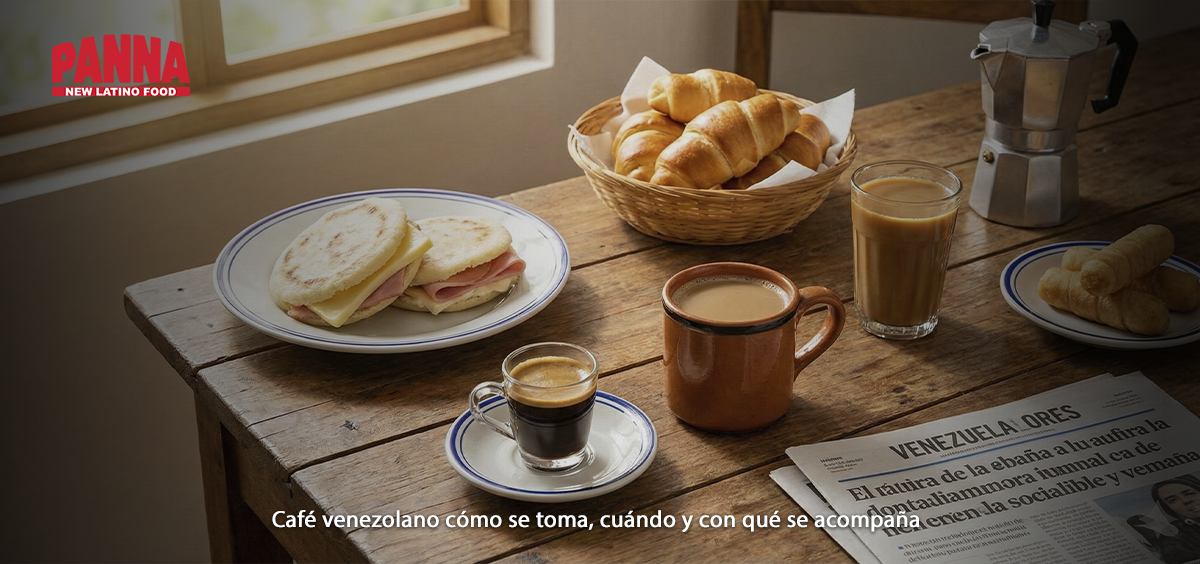
Within Venezuelan food, cachitos respond to a very specific need: solving breakfast in a quick, consistent, and satisfying way.
Unlike dishes that require assembly or last-minute preparation, cachitos are ready to go. They are purchased, served, and eaten without additional steps. That practicality is essential to understanding their role in everyday life.
In urban Venezuelan routines, breakfast is often functional. There is not always time to cook, but there is still an expectation of eating something that truly satisfies. Cachitos meet that need without losing their place within Venezuelan culinary identity.
Venezuelan cachito dough: structure and local adaptation
The dough used for Venezuelan cachitos clearly reflects local adaptation. Unlike croissant dough, which requires a complex lamination process, cachito dough is softer, slightly sweet, and designed for a more direct preparation.
This dough must achieve a precise balance: light enough to avoid heaviness, yet structured enough to hold the filling and maintain its shape during baking.
Fermentation plays a crucial role. It is not just about making the dough rise, but about developing a soft, airy, and uniform crumb. That internal texture is what allows the cachito to feel light despite being a bakery product.
The filling of Venezuelan cachitos: functional simplicity
The traditional filling of a Venezuelan cachito is ham. This choice is not accidental or limited; it follows a logic of balance.
Ham provides saltiness, integrates well with the dough during baking, and does not introduce excess moisture that could compromise the structure. It is a filling that works without requiring complexity.
Over time, variations such as ham and cheese have appeared, but the classic version remains the standard.
This simplicity is exactly what allows the cachito to function across different moments of the day, without becoming heavy or overwhelming.
Baking Venezuelan cachitos: the step that defines quality
Baking is the final step that defines the Venezuelan cachito. It is where the dough develops its final texture and where the entire structure comes together.
A properly baked cachito should have a golden surface, slightly firm on the outside, with a soft and airy interior. It should not be dry or overly dense.
Temperature and baking time must be controlled carefully. Mistakes at this stage directly affect the experience, since texture is one of the most important elements of the product.
Venezuelan cachitos as fast food within Venezuelan cuisine
Within Venezuelan food, cachitos also function as a form of fast food. They do not require utensils, they do not depend on additional sides, and they can be eaten on the go.
However, unlike other fast-food formats, cachitos maintain a clear identity. They do not rely on sauces or external combinations; everything is contained within the product itself.
This makes them efficient, but also culturally coherent within Venezuelan gastronomy.
Venezuelan cachitos in Venezuelan food in Miami
In cities like Miami, where Venezuelan food has grown significantly, cachitos remain a key reference for breakfast.
However, not all versions respect the original logic. The dough texture, the proportion of filling, and the baking point are factors that determine quality.
Anyone who has grown up eating cachitos in Venezuela can quickly identify when one is properly made. It is a simple product, but demanding in execution.
For those searching for Venezuelan food in Miami, cachitos also function as a marker of authenticity.
At Panna, cachitos are understood from their origin
At PANNA, Venezuelan cachitos are prepared with a clear understanding of their history and function within Venezuelan food. They are not reinvented or overcomplicated; they are executed correctly.
The dough is developed to achieve softness and structure, the filling remains faithful to traditional logic, and the baking process is controlled to ensure balance.
Because when a product is simple, there is no room for error.
If you are looking for Venezuelan food in Miami where even the most everyday items are properly executed, PANNA offers cachitos that respect their origin, their evolution, and their place within Venezuelan cuisine.