The Venezuelan hot dog is not a hot dog… even if that’s where it originally comes from. That difference, subtle at first glance, is essential to understanding how such a simple food became one of the clearest expressions of Venezuelan food culture. Because in Venezuela, a hot dog is not just bread and sausage; it is built, layered, and turned into a complete meal that reflects a very specific way of eating.
Talking about Venezuelan hot dogs means talking about the street, the stadium, late nights, and everyday routines. It is one of those foods that appears without planning, eaten standing up or leaning on a counter, and it works precisely because it requires nothing more than hunger and the need to eat well, quickly.
What defines Venezuelan hot dogs
Venezuelan hot dogs start from a familiar base: soft bread and a hot sausage. But the base is never the main point; what matters is everything that comes after.
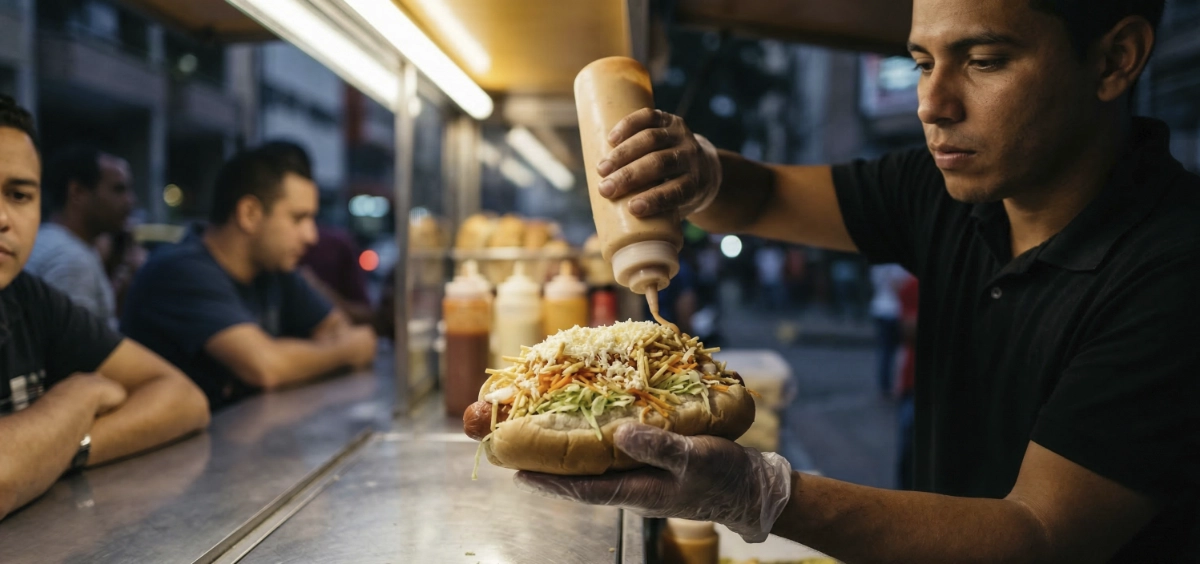
This is where the hot dog is assembled. Layers are added that, far from being random, follow a logic refined over time. Fresh cabbage, shredded carrots, crispy potato sticks, grated cheese, and a combination of sauces that varies depending on the place but always aims for the same result: contrast.
Each ingredient has a role. The cabbage brings freshness, the carrot adds texture, the potato sticks provide crunch, the cheese softens the whole, and the sauces tie everything together. When done right, the Venezuelan hot dog is not chaotic excess; it is a structured build where every bite makes sense.
Venezuelan hot dogs vs American hot dogs
Comparing Venezuelan hot dogs with American hot dogs helps clarify their identity.
The American hot dog is direct, contained, and uniform. Bread, sausage, and a few toppings. Its purpose is clear: quick, efficient, and uncomplicated.
The Venezuelan version, on the other hand, does not aim for simplicity. It is bigger, more loaded, and above all, more personal. Each person builds it their own way. More potato sticks, less cabbage, extra sauce, no cheese… customization is part of the experience.
That difference is not just visual; it defines how it is consumed. While the American hot dog is a finished product, the Venezuelan hot dog is something assembled in the moment.
The logic behind the excess in Venezuelan hot dogs
From the outside, Venezuelan hot dogs may seem excessive. Too many ingredients, too many sauces, too much going on. But that excess makes sense once you understand how they are eaten.
The key is balance. The crunch from the potato sticks, the freshness of the cabbage, the creaminess of the sauces, and the warmth of the base create an experience that does not feel heavy when properly executed.
The issue is not quantity, but proportion. When the balance is off, the hot dog becomes messy or loses its identity. But when done right, every element shows up at the right moment.
Where Venezuelan hot dogs are eaten
Venezuelan hot dogs do not belong to a single place. They are eaten in different contexts, all of them informal.
In stadiums, they are part of the game. They are eaten between innings, without taking your eyes off the field.
On the streets, they appear in carts that become meeting points. In Caracas, in areas like Las Mercedes, Chacaíto, or downtown, hot dogs are part of the nighttime routine.
In Maracaibo, the pace is faster and more intense, but the logic remains the same: eat quickly, eat well, and keep moving.
In other cities, the setting changes, but the purpose does not. The hot dog remains a quick solution, especially at night, when something filling is needed.
Venezuelan hot dogs as everyday food
One of the most interesting aspects of Venezuelan hot dogs is that they are not reserved for special occasions. They are not a rare craving; they are part of everyday life.
They are eaten after going out, at the end of the day, after a baseball game, or simply when there is no desire to cook. They require no planning or special context.
That ease is what keeps them relevant. They do not depend on trends or reinvention. They work because they fit perfectly into daily life.
Why Venezuelan hot dogs do not change
Unlike other foods that evolve with trends, Venezuelan hot dogs have remained largely the same.
They have not been simplified, they have not become minimal, and they have not tried to resemble more “refined” or international versions. They remain abundant, direct, and practical.
That resistance to change is not accidental. It reflects a clear identity. Venezuelan hot dogs do not need reinvention because they already serve their purpose.
Venezuelan hot dogs and food culture
Beyond the dish itself, the Venezuelan hot dog represents a broader way of understanding food in Venezuela.
A practical approach, without pretension, where what matters is that it works. Where flavor, portion, and experience matter more than presentation or sophistication.
It is food that accompanies moments, not interrupts them. Food that appears naturally and is enjoyed without ceremony.
At Panna, we understand how Venezuelans eat
At PANNA, we fully understand that way of eating. We know that Venezuelan food is not always about elaborate dishes or special occasions, but also about solving everyday meals in a satisfying way.
That is why our approach is built around food that works, that fits into daily routines, and that keeps the true flavor of Venezuelan cuisine without unnecessary complications.
For those looking for Venezuelan food in Miami that reflects how people actually eat back home, PANNA continues to do exactly that: food made to satisfy, to share, and to be enjoyed without overthinking it, because when something works, there is no need to change it.