At the Venezuelan table, soup doesn’t start the meal; it often defines it. Far from being understood as a light first course, soup plays the role of a complete meal, especially on weekends or on days when the body craves something hearty. Mondongo, chicken soup, hervidos, and cruzados aren’t served to “prep the stomach”; they are served to truly nourish. They are dishes meant for sitting down, having seconds, and feeling satisfied.
This way of thinking about soup responds to a practical and cultural logic; in a country of varied climates and intense rhythms, soup offers warmth, rest, and balance. It brings together proteins, root vegetables, greens, and broth in a single bowl. There’s no need for complex side dishes; a good bowl of Venezuelan soup stands on its own. That’s why, when talking about everyday Venezuelan food, soups take center stage, even if they are sometimes downplayed in culinary discussions.
WEEKENDS TASTE LIKE SOUP In many homes, soup is synonymous with the weekend. It is prepared ahead of time, unhurriedly, and usually gathers several people around the pot. On Saturday or Sunday, while the house moves slowly, the soup simmers over medium heat, concentrating its flavors. It’s not an improvised meal; it’s a decision. The meat is cut, the root vegetables are peeled, and the broth is left to do its work.
This custom repeats from generation to generation. The aroma of a chicken soup or an hervido announces rest, a gathered family, and a long table. It is served hot, in a deep bowl, and accompanied, at most, by an arepa or bread. There is no rush. The soup is eaten slowly, spoonful by spoonful, like someone taking a breather.
MONDONGO, CHICKEN SOUP, AND HERVIDOS Among the most representative soups is mondongo—thick, powerful, and packed with ingredients. It has meat, root vegetables, greens, and that rich broth you can recognize from a mile away. It isn’t a light or discreet soup; it’s a dish with character, designed to nourish and restore energy. It is eaten hot and usually lasts for several days, getting even better as it rests.
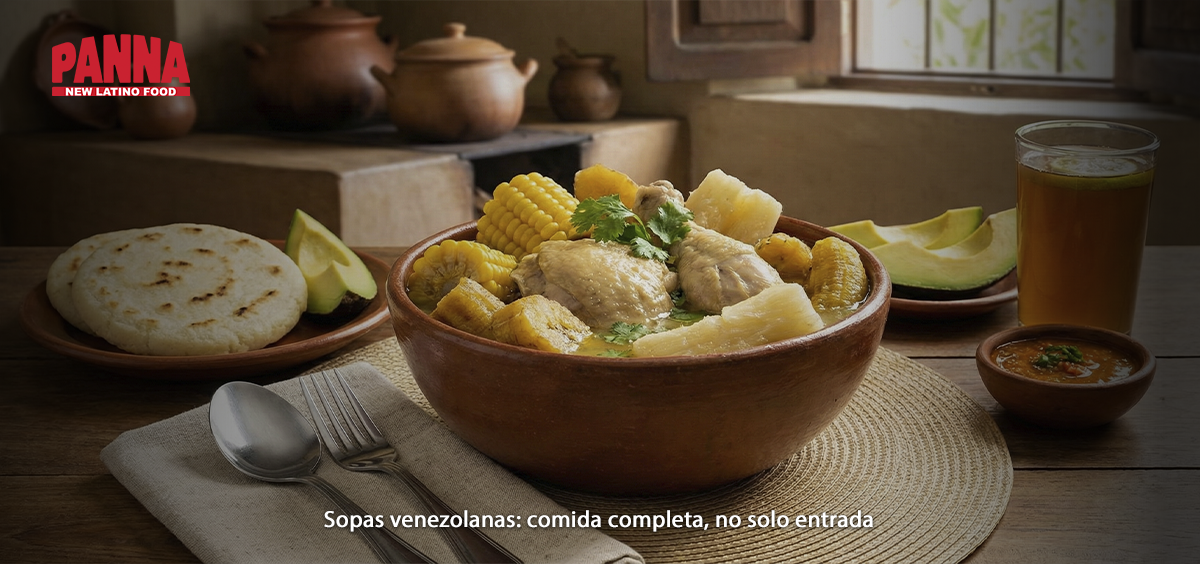
Chicken soup holds another fundamental place. Present in homes, local eateries (fondas), and family celebrations, it is a flexible recipe that allows for regional variations. Potatoes, yuca, taro (ocumo), pumpkin (auyama), and cilantro usually make an appearance, creating a balance between softness and substance. Hervidos, on the other hand, stand out for their simplicity. Meat and root vegetables cooked in a clean broth, where the main flavor comes from the raw ingredients and a well-crafted aliño (seasoning base).
SOUPS THAT SUSTAIN THE ROUTINE Beyond the weekend, soup also solves complicated days. During times of sickness, exhaustion, or cold weather, a hot soup is almost medicine. It’s no coincidence that many grandmothers recommend “a little soup” (una sopita) for any ailment. Soup nourishes, hydrates, and comforts all at once.
Plus, it is an efficient meal. With just a few ingredients, you get a complete dish capable of feeding several people. This efficiency explains its permanence in Venezuelan cuisine. It isn’t a fad or a trend; it’s a proven solution. In that sense, soup perfectly summarizes the philosophy of the local table: making the most of things, balancing, and caring.
BROTH, TEXTURE, AND THE PERFECT POINT A good broth is the base of every Venezuelan soup. It shouldn’t be cloudy or excessively greasy, but it must be deep. The initial aliño, the cooking time, and the order of the ingredients make all the difference. First the meats, then the harder root vegetables, then the softer ones. Nothing is done at random.
Texture matters too. As a rule, Venezuelan soups aren’t blended or creamy; you can recognize the ingredients. Every spoonful should offer variety. Meat, yuca, potato, broth. That balance is part of the enjoyment and defines the dish’s character.
SOUPS AND VENEZUELAN FOOD TODAY For those looking for authentic Venezuelan food, even abroad, soups are a clear benchmark. Recognizing a good broth, well-cooked meat, and a balanced aliño builds immediate trust.
In cities like Miami, many diners judge a place’s quality by its soup, because there’s no way to disguise it there. Soup reveals technique, respect for the process, and knowledge of tradition. It allows no shortcuts. That’s why it remains one of the most highly valued dishes by those looking to reconnect with the everyday Venezuelan table.