Everyday Venezuelan food is not random, nor is it the result of improvised combinations; it follows a clear, structured logic that is repeated across households throughout the country. While each home may have its variations, there is a consistent pattern: a complete Venezuelan plate always aims for balance in flavor, texture, and satiety.
Talking about Venezuelan food means talking about combinations that work together, not by coincidence, but by design. A plate is not assembled with whatever is available, but with what is necessary. That distinction is key to understanding why Venezuelan cuisine remains so recognizable, so satisfying, and so difficult to replicate when that structure is lost.
Everyday Venezuelan food and its core structure
When discussing everyday Venezuelan food, a structure appears almost automatically: protein, carbohydrate, legumes, and a complementary element.
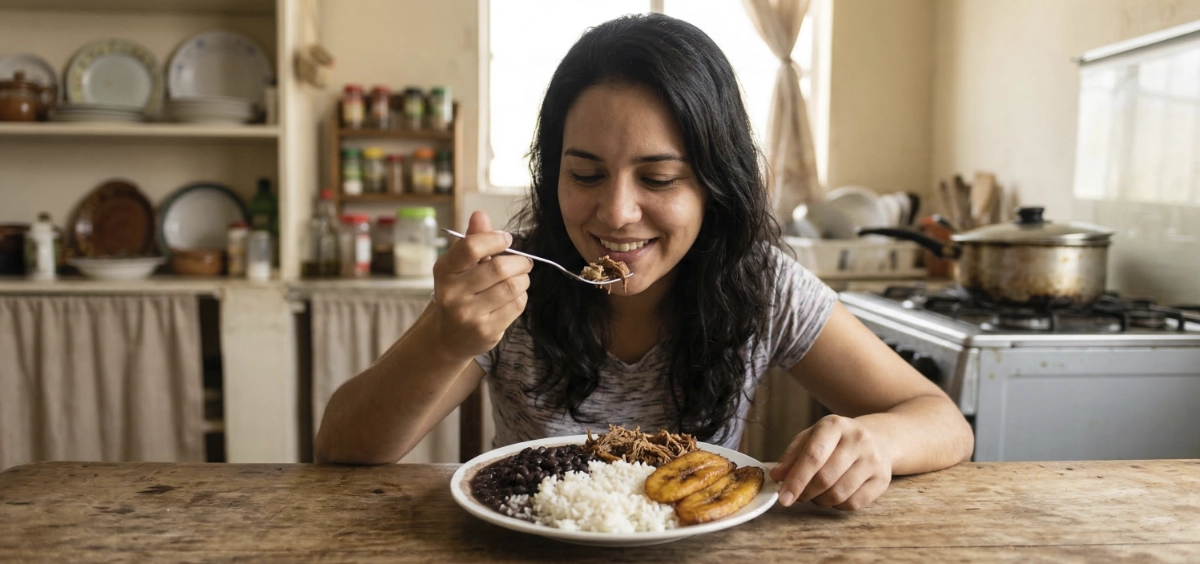
The most recognizable example is pabellón criollo, but this logic extends beyond that specific dish. White rice, black beans, shredded beef, and fried sweet plantains. Each component serves a defined purpose within the plate.
Rice provides neutrality and volume; black beans add depth and moisture; shredded beef contributes intensity and texture; and the sweet plantains introduce contrast and balance.
This is not an accidental combination. It is a structure that has been repeated across generations because it works.
How a complete Venezuelan plate is assembled
Building a complete Venezuelan plate requires an understanding of proportions. It is not about filling the plate indiscriminately, but about distributing elements so that each one has presence without overpowering the others.
Rice often forms a significant base, but it should not dominate. Beans must have enough liquid to integrate with the dish, without turning into a soup. The protein, whether shredded beef, chicken, or pork, should be evenly distributed, not concentrated in one area.
Fried sweet plantains are not decorative. They are essential, providing the sweetness that balances the rest of the flavors.
This balance is rarely explained, but it is immediately recognized when done correctly.
Flavor logic in everyday Venezuelan food
Everyday Venezuelan food follows a clear principle: contrast.
Rather than focusing on a single flavor profile, it combines multiple ones in the same plate. Sweet, savory, rich, and fresh elements coexist.
Black beans may have a slight sweetness, the protein is typically well seasoned, the plantains add a distinct sweetness, and the rice acts as a neutral base.
This interplay prevents the dish from becoming monotonous. Each bite offers variation while maintaining coherence.
Texture: the other key balance in Venezuelan plates
Beyond flavor, texture plays a fundamental role in Venezuelan food.
A complete Venezuelan plate combines soft, creamy, and firm elements. Rice is loose, beans are moist, the protein is fibrous, and the plantains are soft with lightly caramelized edges.
This variation prevents the experience from becoming repetitive.
Without it, the dish loses its appeal.
Everyday Venezuelan food as part of routine
One of the defining aspects of everyday Venezuelan food is that it is not reserved for special occasions. It is part of daily life.
It is eaten during the week, at home, in restaurants, during work hours. It is the kind of meal that satisfies and sustains the day.
It does not require ceremony or explanation.
That is precisely why it remains so relevant.
Adaptations without losing structure
Although the base structure remains consistent, everyday Venezuelan food allows for variations.
The protein can change: shredded beef, chicken, ground meat, or pork. Beans may be replaced with lentils or even omitted in some cases.
But the overall structure persists.
There is always an intention to create balance and completeness.
Venezuelan food in Miami and staying true to its structure
In cities like Miami, where Venezuelan food has gained visibility, one of the biggest challenges is maintaining this structure.
It is not enough to offer Venezuelan dishes; the way they are built must also be respected.
For those searching for Venezuelan food in Miami, the difference between a correct plate and an authentic one lies precisely in that balance.
At Panna, Venezuelan plates are built the right way
At PANNA, we understand that everyday Venezuelan food is not about excess, but about structure.
That is why our plates respect this logic: clear proportions, balanced flavors, and combinations that work as a whole.
If you are looking for Venezuelan food in Miami that reflects the real way Venezuelan meals are built, PANNA offers a dining experience where every element serves a purpose, because in Venezuelan cuisine, balance is not optional, it is the foundation of everything.
CATEGORY: Essence of Venezuelan Cuisine
SUBCATEGORY: Flavors and Aromas
POST Nº: 209
White rice in Venezuelan food: technique, proportions, and the mistakes that change the result
White rice in Venezuelan food is not a neutral side dish or a filler without intention; it is a structural element that holds the plate together and allows the rest of the components to function as a whole. In any Venezuelan household, rice appears naturally, without excessive protagonism, yet with a clear responsibility: to provide a base, absorb flavors, and bring order to the plate from the simplest level.
In Venezuelan cuisine, few things seem as easy and, at the same time, generate as many mistakes as white rice. Because cooking it is not difficult, but cooking it well, loose, at the exact point, with separated grains, requires technique, attention, and repetition. And when rice fails, the entire plate is affected, even if everything else is well executed.
White rice in Venezuelan food as the real base of the plate
White rice in Venezuelan food plays a role that goes far beyond being a side; it is the element that organizes the plate and balances stronger flavors. In a pabellón criollo, for example, rice allows the intensity of shredded beef and the depth of black beans to coexist without overwhelming the palate, creating space for each element to stand without dominating.
That neutrality does not mean lack of flavor, but control. Rice absorbs the juices from the beans, blends with the protein, and softens the overall profile, creating continuity between elements. When rice is poorly made, too wet or clumped, that harmony breaks and the dish becomes heavy and unstructured.
White rice technique in Venezuelan food: more precise than it seems
The technique behind white rice in Venezuelan food appears simple, but it is precise in execution. Everything begins with the ratio between rice and water, which must be exact to achieve a grain that is fully cooked yet firm. Too much water turns the rice into a soft mass; too little leaves it undercooked.
The initial step, though subtle, matters. A small amount of oil, the grain lightly sealed before adding water, and in some cases a minimal touch of garlic or onion, help develop a base flavor without interfering with its neutral role.
The cooking point is critical. It begins over medium heat, then the temperature is reduced and the pot is covered, allowing steam to complete the process. That final stage, where the rice settles, is just as important as the cooking itself.
Common mistakes in Venezuelan white rice that affect the entire dish
One of the most frequent mistakes in white rice in Venezuelan food is overhandling. Constantly stirring the rice breaks the grains and releases excess starch, creating a sticky texture that does not belong to Venezuelan tradition.
Another common error is poor water control. Too much water is often added out of fear that the rice will remain undercooked, but that excess eliminates the loose texture that defines properly made rice.
It is also common to cover and uncover the pot without purpose, interrupting the steaming process. Rice requires stability, not constant intervention.
These details may seem minor, but they completely transform the result and impact the perception of the entire plate.
White rice and its relationship with beans and stews
In Venezuelan food, white rice does not stand alone. Its relationship with black beans, stews, and proteins is what gives it meaning within the plate.
When rice comes into contact with the broth of black beans, it absorbs flavor without losing structure; when mixed with shredded beef or chicken, it balances the intensity of the stew and stabilizes each bite.
That interaction is essential. Rice is not there to stand out; it is there to integrate. When it fulfills that role properly, the dish becomes coherent, complete, and satisfying.
White rice in everyday Venezuelan routine
White rice in Venezuelan food is part of everyday life. It appears in home-cooked meals, in restaurants, in workday lunches that need to be practical and filling.
It requires no explanation or ceremony. It is served on a flat plate, alongside the rest of the food, exactly as it should be.
That consistency is what makes it a defining element of Venezuelan culinary identity. It is not occasional; it is constant.
Variations without losing its essence
Although the base technique remains consistent, white rice in Venezuelan food allows for small variations that do not alter its essence. It may include a hint of garlic, a light broth, or minor adjustments, but it must always maintain its defining characteristic: loose grains, dry on the surface, yet fully cooked inside.
When that condition is lost, it is no longer traditional Venezuelan rice.
White rice in Venezuelan food in Miami
In cities like Miami, where Venezuelan food has gained strong visibility, white rice remains a silent indicator of quality. It is not the first thing people evaluate, but it is one of the clearest signs of proper execution in the kitchen.
Well-made rice reflects technique, care, and respect for tradition; poorly made rice reveals neglect, even if the rest of the dish is acceptable.
For those familiar with Venezuelan food, that detail does not go unnoticed.
At Panna, rice is not filler, it is structure
At PANNA, we understand that white rice in Venezuelan food is not a secondary element, but a base that supports the entire plate. That is why we prepare it with precision, respecting proportions, timing, and technique, ensuring that every grain is in its proper state and fulfills its role within the dish.
If you are looking for Venezuelan food in Miami where every element makes sense, where rice supports without interfering and balances without disappearing, PANNA offers a culinary experience that respects the essentials, because in Venezuelan cuisine, even the simplest elements must be done right.