In Venezuelan cuisine, there are flavors that don’t announce themselves, but they are everywhere, and aliño (seasoning base) is one of them. It isn’t served on its own, you don’t see it in the final dish, and it’s rarely mentioned when describing a recipe, but without it, the food simply wouldn’t taste the same. It is the silent base of stews, soups, rice dishes, meats, and fillings; the starting point that defines the character of everyday Venezuelan food. Understanding aliño is understanding why our dishes have such a clear identity, even when the main ingredients change.
Venezuelan aliño doesn’t follow rigid formulas or exact measurements. You learn by watching, smelling, and tasting. Every home has its version, but they all share a common logic: fresh ingredients, a fine chop, and patient cooking. It is not about complexity, but balance. That is why, even though many dishes vary by region or occasion, the aromatic base is usually the same, creating a consistency that runs through the country’s entire gastronomy.
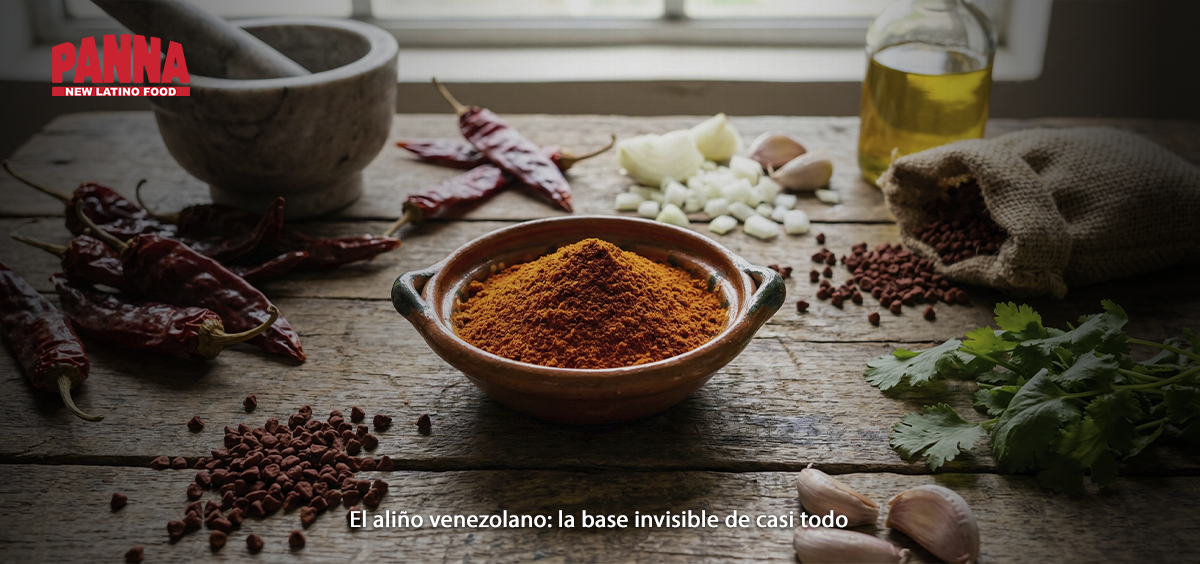
INGREDIENTS THAT DEFINE A FLAVOR Classic Venezuelan aliño starts with a simple, recognizable combination. Onion, garlic, sweet pepper (ají dulce), and bell pepper form the core. Depending on the dish, scallions, cilantro, or raw cane sugar (papelón) are added, but always in moderation. Ají dulce, in particular, is the soul of the aliño; it provides aroma without heat, depth without aggressiveness. It is that ingredient that sets a clear difference from other Latin American cuisines and gives the Venezuelan stew its unmistakable profile.
These ingredients are finely chopped and sautéed over medium heat, without rushing. The goal isn’t to brown them, but to sweat them; to let the flavors meld and release their aroma without burning. That moment, when the kitchen starts to smell like “food in progress,” is a universal sign in Venezuelan homes. That is where the dish truly begins, even if everything else is still missing.
ALIÑO AS A STARTING POINT In daily practice, aliño serves a structural purpose; it is the first step in most preparations and the reason a stew has depth right from the start. Shredded beef, chicken stew, black beans, lentils, yellow rice, or chicken soup all start with the same gesture: heating the pot, adding fat, and starting to sauté the aliño. From there, each recipe takes its own path, but always on that common base.
This logic explains why many Venezuelan dishes, even though they are different from each other, share a sense of familiarity. Aliño creates continuity. It doesn’t matter if it’s a simple weekday meal or a more elaborate dish; the aromatic base establishes a common thread that organizes the flavor and prevents forced improvisations.
REGIONAL AND PERSONAL VARIATIONS Although the structure of the aliño is shared, there are clear regional variations. In the eastern part of the country, more ají dulce and scallions are typically used, achieving a more fragrant profile. In the Andes, the aliño might be more restrained, with less bell pepper and a stronger garlic presence. In the Plains (Los Llanos), it is reinforced with papelón and, in some cases, local herbs. These differences don’t break the identity; they enrich it.
At home, every family adjusts the aliño to their taste. Some blend it, some chop it roughly, some prepare it ahead of time and keep it in the fridge. There is no single correct way. What matters is respecting the process and understanding its function. A well-made aliño doesn’t impose itself, it accompanies; it doesn’t cover up the main ingredient, it enhances it.
THE MISTAKE OF UNDERESTIMATING IT One of the most common mistakes when replicating Venezuelan food abroad is minimizing the aliño. Steps are skipped, ingredients are reduced, or the cooking is rushed. The result is usually a decent dish, but flat. It lacks depth; it lacks that flavor that “sticks around.” Aliño needs time and attention; it doesn’t allow for shortcuts if you want an authentic result.
That is why, when someone says a Venezuelan meal “tastes weird,” the problem is often not the recipe, but the base. A good aliño isn’t noticed in isolation, but its absence is felt immediately. It is a flavor built slowly that supports everything else.
ALIÑO AS CULINARY IDENTITY Beyond its technical function, aliño is a reflection of Venezuelan cuisine itself. It is simple, flexible, and deeply sensory. It doesn’t follow fads or trends, but the accumulated experience of generations cooking with what’s available, adjusting flavors, and learning to listen to the pot. That practical wisdom is part of the country’s gastronomic heritage.
Anyone who learns to make a good aliño is basically learning to cook Venezuelan food. They learn to respect cooking times, recognize aromas, and build flavor from the ground up. It’s no coincidence that many grandmothers teach how to cook starting right there. Everything else comes later.
AT PANNA, FLAVOR STARTS FROM THE BASE At PANNA, the aliño is prepared the way it always has been: with fresh ingredients, a precise chop, and patient cooking. It is the first step for many of our dishes and one of the reasons the flavor feels familiar from the very first bite. We don’t improvise the base, because we know that is where the key lies.
For those looking for Venezuelan food in Miami that respects this true logic of local cooking, the aliño makes all the difference. At PANNA, every dish starts there, from that invisible base you don’t see, but that holds everything together. Because when the base is done right, the flavor speaks for itself.