Black beans in Venezuelan food are not just another side dish, nor are they limited to pabellón criollo; they are one of the most consistent, versatile, and essential foundations of everyday Venezuelan cuisine. Their presence is not tied to a single recipe or occasion, but to a broader culinary logic that has been repeated for generations, where beans play a clear and functional role within the balance of the plate.
In any Venezuelan kitchen, black beans appear naturally, often prepared in large quantities and used across multiple meals without losing their identity. They are not occasional; they are structural. Understanding that is key to truly grasping how Venezuelan food works beyond its most iconic dishes.
Black beans in Venezuelan food as a structural base of the plate
Black beans in Venezuelan food act as a connector within the plate. While rice provides neutrality and protein adds intensity, beans introduce depth, moisture, and continuity, allowing all elements to integrate seamlessly.
In a pabellón criollo, for example, black beans are not there just for tradition; their broth blends with the rice, softens the shredded beef, and creates a texture that allows the dish to flow. Without them, the plate becomes drier, more fragmented, and less cohesive.
That ability to unify is what makes black beans indispensable. They are not a side; they are a functional base.
Black beans in Venezuelan food: technique and cooking process
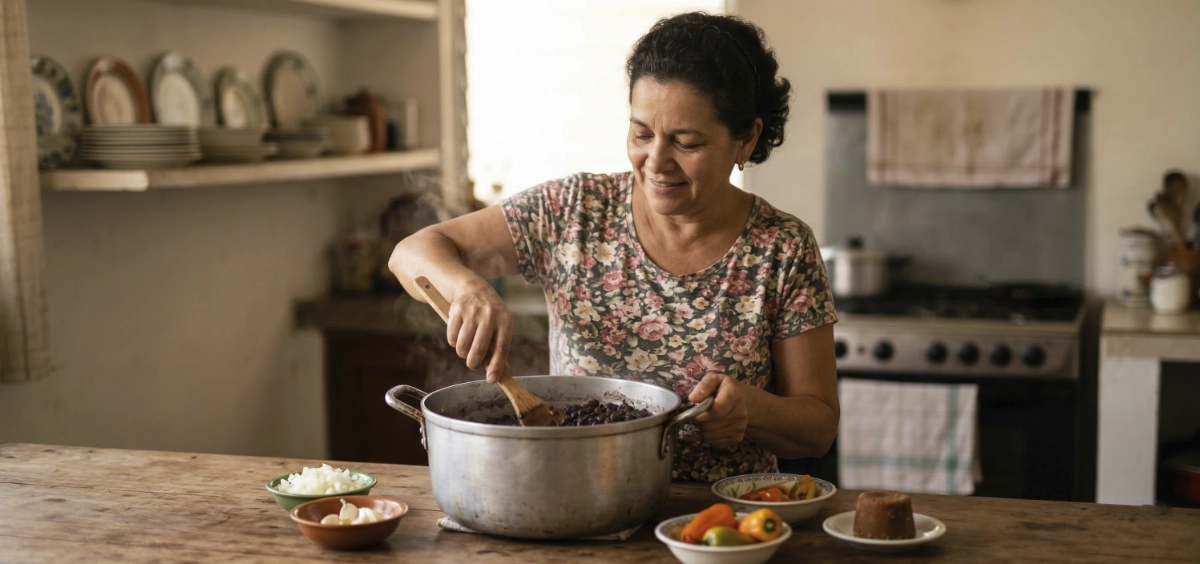
Preparing black beans in Venezuelan food requires more than time; it requires understanding the process. It begins with cooking the beans until they are tender but still hold their shape, without breaking apart. That point defines the final texture.
Then comes the seasoning, where ingredients like onion, garlic, and sweet peppers are incorporated, and depending on the region, a touch of panela (unrefined cane sugar) may be added to introduce subtle sweetness. This seasoning is not added at the beginning, but after the beans are cooked, allowing the flavor to develop gradually.
Finally, there is resting time. Beans are not truly ready when the heat is turned off; they are ready when the flavors settle. That is why they often taste better the next day.
Black beans in Venezuelan food: sweet or savory
Within Venezuelan food, few debates are as persistent as this one: sweet or savory black beans. It is not a minor difference; it reflects two distinct approaches to flavor.
In many central and eastern regions of Venezuela, it is common to add panela at the end of cooking, creating a subtle contrast that pairs especially well with rice and fried sweet plantains. In western regions, however, beans are typically prepared fully savory, with a stronger presence of seasoning and spices.
Both versions are valid. Both reflect regional traditions. And together, they show the diversity within Venezuelan cuisine.
Black beans in Venezuelan food beyond pabellón
Limiting black beans in Venezuelan food to pabellón is an oversimplification. In practice, beans appear in many everyday preparations.
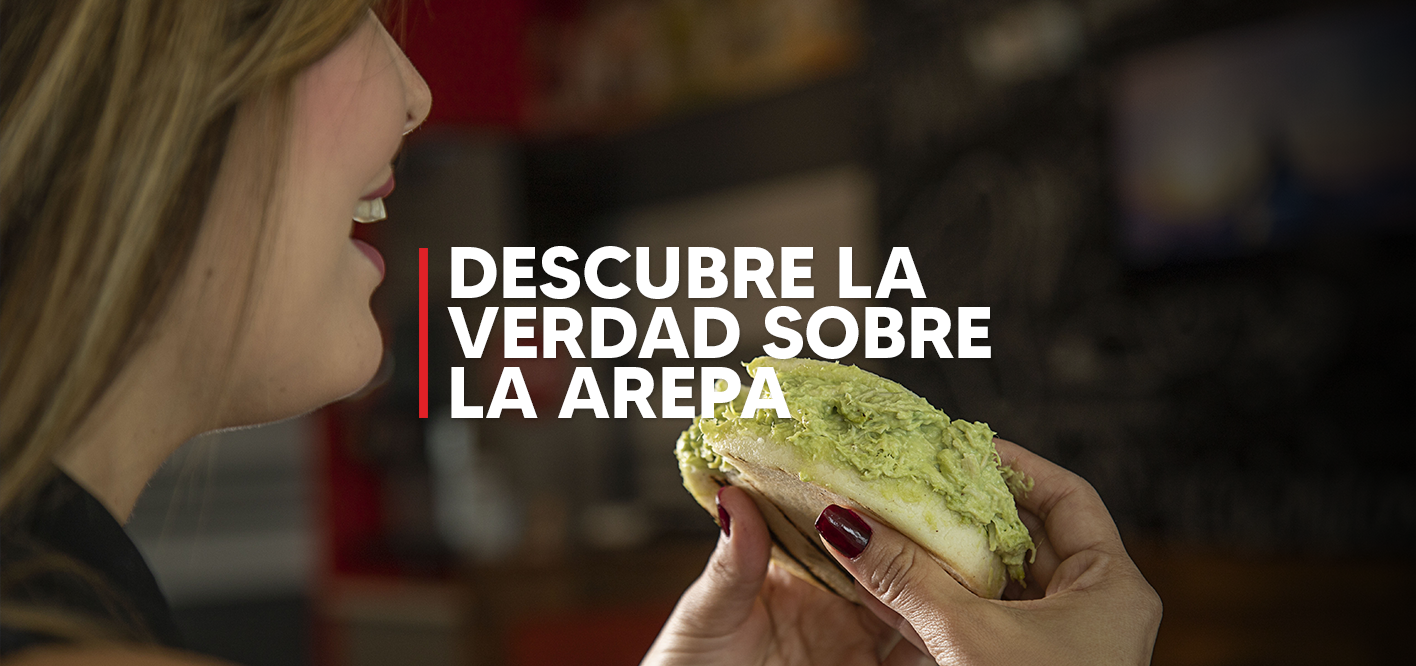
They are used as fillings for arepas, especially the classic “domino”; they are included in empanadas; they can be served as a main dish alongside cheese and arepas; and in some regions, they are transformed into thicker soups or cream-based preparations.
This versatility allows beans to remain relevant without being tied to a single format. They adapt, but their function remains consistent.
The importance of broth in black beans in Venezuelan food
One of the most important aspects of black beans in Venezuelan food is the broth. It is not just about the beans themselves, but about the liquid that surrounds them and defines how they integrate into the plate.
The broth must have body without becoming heavy; it must be flavorful without overwhelming. It is what allows the beans to mix with rice and provide moisture without dominating the dish.
If the broth is too thick, the beans lose fluidity; if it is too thin, they lose presence.
That balance is part of the technique.
Black beans in Venezuelan food as part of everyday routine
Black beans in Venezuelan food are part of daily life. They are prepared in batches, stored, reheated, and reused across different meals throughout the week.
It is common for beans cooked one day to taste even better the next, once the flavors have fully settled and integrated.
This is not accidental. It is part of how they function within home cooking.
Beans are not designed for a single moment, but for continuity.
Black beans in Venezuelan food in Miami
In cities like Miami, where Venezuelan food has gained strong presence, black beans remain a key indicator of quality. They may not be the most visually striking element on the plate, but they reveal a great deal about how the kitchen operates.
For those searching for Venezuelan food in Miami, well-made beans signal technique, patience, and respect for the cooking process. It is not only about flavor, but about texture, broth, and overall balance.
That level of detail distinguishes a correct plate from a truly well-executed one.
At Panna, black beans are cooked with time and purpose
At PANNA, we understand that black beans in Venezuelan food are not a secondary element, but a core component that supports the entire plate. That is why we cook them with time, respecting the texture of the beans, the balance of seasoning, and the consistency of the broth, ensuring that every spoonful contributes to the dish as a whole.
If you are looking for Venezuelan food in Miami where the foundation of the plate is treated with the same care as its most visible elements, PANNA offers black beans that fulfill their real role: adding depth, bringing the dish together, and reinforcing the full experience of Venezuelan cuisine.